A guest stays with you, leaves a glowing review and then vanishes. The following year they book somewhere else, perhaps through a portal that takes a commission. Yet you knew their name, their dates and their preferences. A hotel CRM, or a CRM for any kind of accommodation, exists for exactly this reason: it turns the data you already collect into lasting relationships, so guests who enjoyed their stay have a real reason to come back and recommend you.
What a CRM is and why small properties need one too
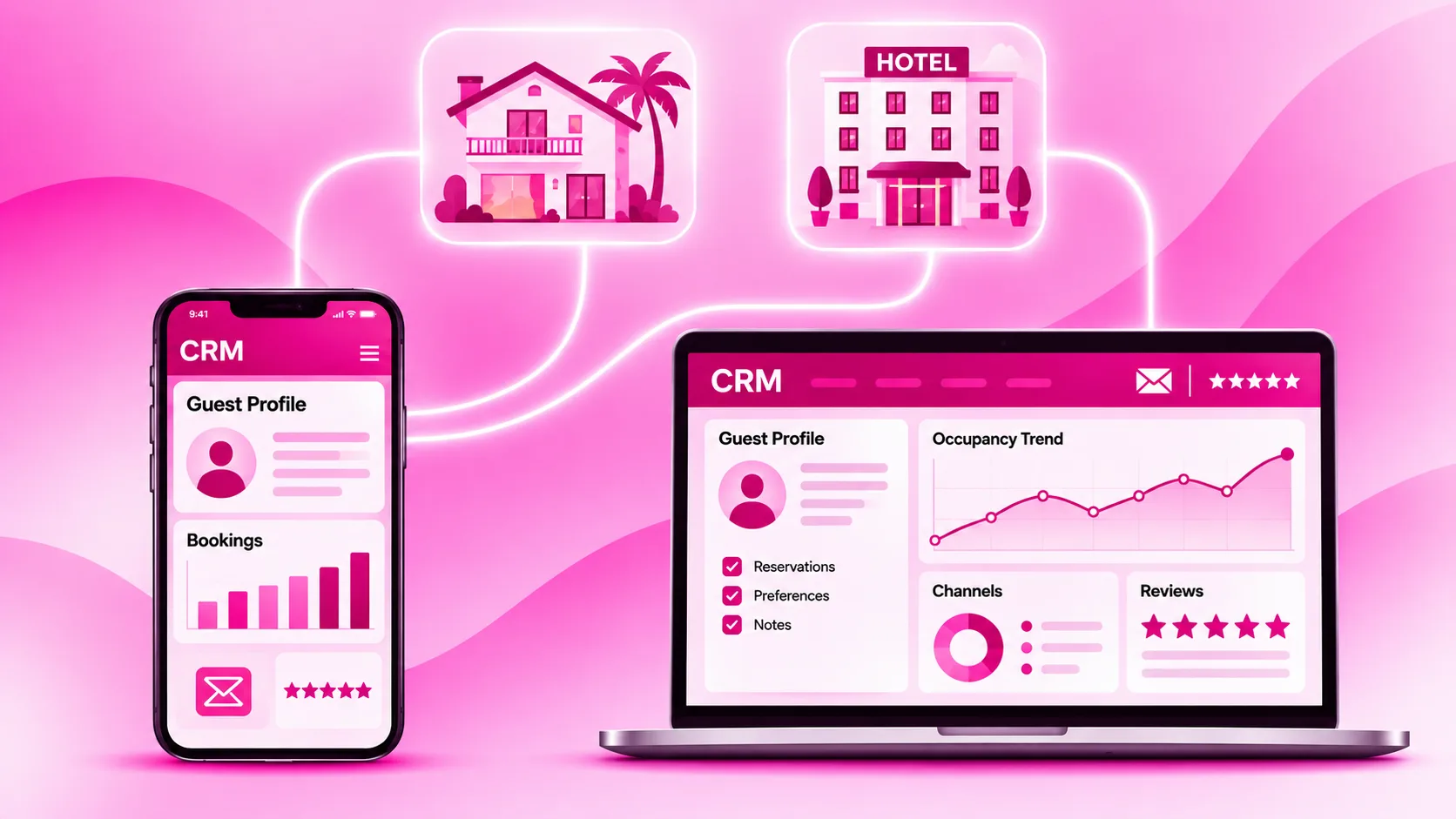
CRM stands for Customer Relationship Management. In practice, it is an organised database of people, with the full history of every contact: stays, requests, preferences, messages, quotes and reviews.
Many owners assume it is a tool for big hotel chains. It isn't. A vacation rental, a B&B or a small hotel also has repeat guests, enquiries coming in from several channels and information scattered across emails, chats and spreadsheets. A CRM brings everything into one place and makes it usable.
What sets it apart from a simple address book is context. You don't just know who a guest is; you know what they did with you and what might appeal to them next time.
The real benefits of guest loyalty
Keeping a guest usually costs less than winning a new one. People who already know you trust you, read your messages more carefully and feel less need to compare dozens of alternatives.
- More direct bookings: returning guests can book through your website instead of going through OTAs.
- Qualified word of mouth: guests who feel recognised share their experience with friends and colleagues.
- Stronger low-demand periods: you can send targeted offers to people who have already shown interest in those dates.
- Better service: remembering preferences and requests makes hospitality more personal, with little extra effort.
Good to know: loyalty doesn't come from promotional emails; it comes from a well-run stay. A CRM amplifies a great experience, but it can't replace one.
Which data to collect (and which to leave out)
A good CRM isn't the one holding the most information. It's the one holding the right information, kept up to date and actually used. Only collect what helps you offer better service or more relevant communication.
| Data type | Example | What it's for |
|---|---|---|
| Contact details | Name, email, preferred language | Writing in the right language and tone |
| Stay history | Dates, length of stay, unit booked, channel | Understanding habits and preferred periods |
| Trip type | Couple, family, business, group | Suggesting relevant offers and services |
| Stated preferences | High floor, cot, parking, arrival time | Preparing the welcome in advance |
| Feedback | Reviews, complaints, compliments | Improving service and saying thank you |
| Consents | Permission to receive marketing messages | Sending marketing only to those who agreed |
Avoid recording unnecessary personal details or subjective judgements. Every piece of data you keep is data you have to protect.
Segmentation: talking to the right person
Segmentation means splitting your contacts into similar groups, so each message reaches people who are likely to care. A newsletter that's the same for everyone gets ignored; a message written for a specific group gets read.
Here are some useful segments for an accommodation business:
- guests who have returned at least twice;
- families with children, for offers tied to school holidays and family events;
- business travellers, interested in short midweek stays;
- international guests, grouped by language;
- people who asked for a quote but didn't book;
- guests who haven't stayed for a long time and might need a gentle reminder.
Tip: start with three or four simple segments. Overly detailed segmentation at the beginning is hard to maintain, and you'll end up not using it.
Email marketing for hotels and rentals: what to send and when
With a CRM, email marketing stops being an occasional blast and becomes a journey. Each stage of the guest relationship has its own natural message.
- After an enquiry: a fast, clear reply with the requested details and an invitation to book direct.
- Before arrival: practical directions, check-in times and available extras. This is the best moment for a gentle upsell.
- After check-out: a sincere thank-you and an invitation to leave a review.
- In the following months: a few genuinely useful messages, such as local events, new services or a perk for returning guests.
- Ahead of their favourite period: a note to guests who stayed at that time before, inviting them to book again.
Frequency matters. A few relevant emails beat a constant stream of promotions: people who feel bombarded unsubscribe or, worse, mark your messages as spam.
Privacy and consent: the foundation
Handling personal data means complying with the GDPR, the EU data protection regulation, and any other applicable privacy rules. In short, every piece of data must be collected for a clear purpose, stored securely and used only for what you stated in your privacy notice.
Service messages related to the stay, such as arrival instructions, are different from promotional messages. Marketing generally requires a valid legal basis, typically explicit consent, and guests must be able to unsubscribe easily at any time.
Watch out: data collected to meet legal obligations, such as ID details that Italian hosts must send to the police through the Alloggiati Web portal, must not be reused for marketing. For your specific case, talk to a privacy adviser and check the guidance published by your national data protection authority.
How to choose a CRM for your hotel or vacation rental
You don't need the most complex tool on the market. You need one your team will use every day without friction. Before choosing, consider:
- Integration with your PMS: if booking data flows in automatically, you avoid double entry and errors.
- Ease of use: clear guest profiles, fast search and access from a smartphone.
- Segmentation and sending: the ability to build groups and send targeted messages.
- Consent management: a record of who agreed to what, with the option to withdraw.
- Multilingual support: essential if you host guests from different countries.
- Security: personal logins, role-based permissions and regular backups.
A cloud-based CRM is always up to date and available from anywhere, whether you're at the front desk or on the road. You also don't have to worry about installations, manual updates or backups on the office computer: the provider takes care of them, so you can focus on your guests.
Common mistakes to avoid
Even with the right tool, a few recurring mistakes can undo your efforts. Spotting them early saves time and protects your property's reputation.
- Collecting data and never using it: a full but idle database brings no return.
- Sending the same email to everyone: generic messages are the first to be ignored.
- Letting records go stale: duplicate contacts and wrong addresses weaken every campaign.
- Relying only on discounts: recognition and attention are often worth more than a lower rate.
- Overlooking consent: a privacy issue can cost far more than any campaign earns.
Quick checklist
- I have a single guest database, connected to my bookings.
- I collect only the data I really need.
- I record marketing consents and offer one-click unsubscribe.
- I've defined three or four starting segments.
- I have a message ready for each stage: enquiry, pre-arrival, post-stay, return.
- I regularly check opens, replies and the bookings each message generates.
- I use recorded preferences to improve the welcome.
Ready to turn guests into regulars?
With ForGuest you can manage contacts, stay history and communications in a cloud CRM connected to your business. We'll show you how to set it up for your property, step by step.
Frequently asked questions.
What is a hotel CRM?
It is a central guest database holding stay history, preferences, communications and consents, used to manage and improve the relationship with every guest.
Does a B&B or small vacation rental need a CRM?
Yes. Small properties also have repeat guests and enquiries from several channels: a CRM helps you remember preferences, send targeted messages and encourage direct bookings.
Can I send newsletters to every guest who has stayed with me?
Promotional messages generally require a valid legal basis, typically consent, plus an easy way to unsubscribe. Check your specific case with a privacy adviser.
What is the difference between a CRM and a PMS?
A PMS manages bookings, availability and operations; a CRM focuses on the guest relationship. When integrated, they avoid double entry and give you a complete view.
How many emails should I send to guests?
Few and relevant: one for each key stage of the stay and a handful of useful messages in the months after, avoiding overly frequent promotions.