You have great photos, excellent reviews and a property guests love. Yet your website brings in few enquiries and hardly any bookings. It happens all the time: an accommodation website is not a shop window to look at, it is a sales tool. And to sell, it needs a few specific elements. Let's go through them one by one.
Why your own website still matters
Online travel agencies (OTAs) bring visibility, but the guest stays theirs: they take a commission, set the rules and often don't even give you a direct contact with the guest.
Your website is the only channel you truly control. You choose rates, conditions, content and tone of voice. Many travellers, after finding a property on an OTA, search for it on Google to see what it is really like, read more details or check whether booking direct is a better deal. If they land on a slow, outdated site with no easy way to book, they go straight back to the OTA.
A good website doesn't replace the OTAs: it works alongside them and wins back part of your bookings on better terms.
First impressions: mobile, speed and trust
Designed for smartphones first
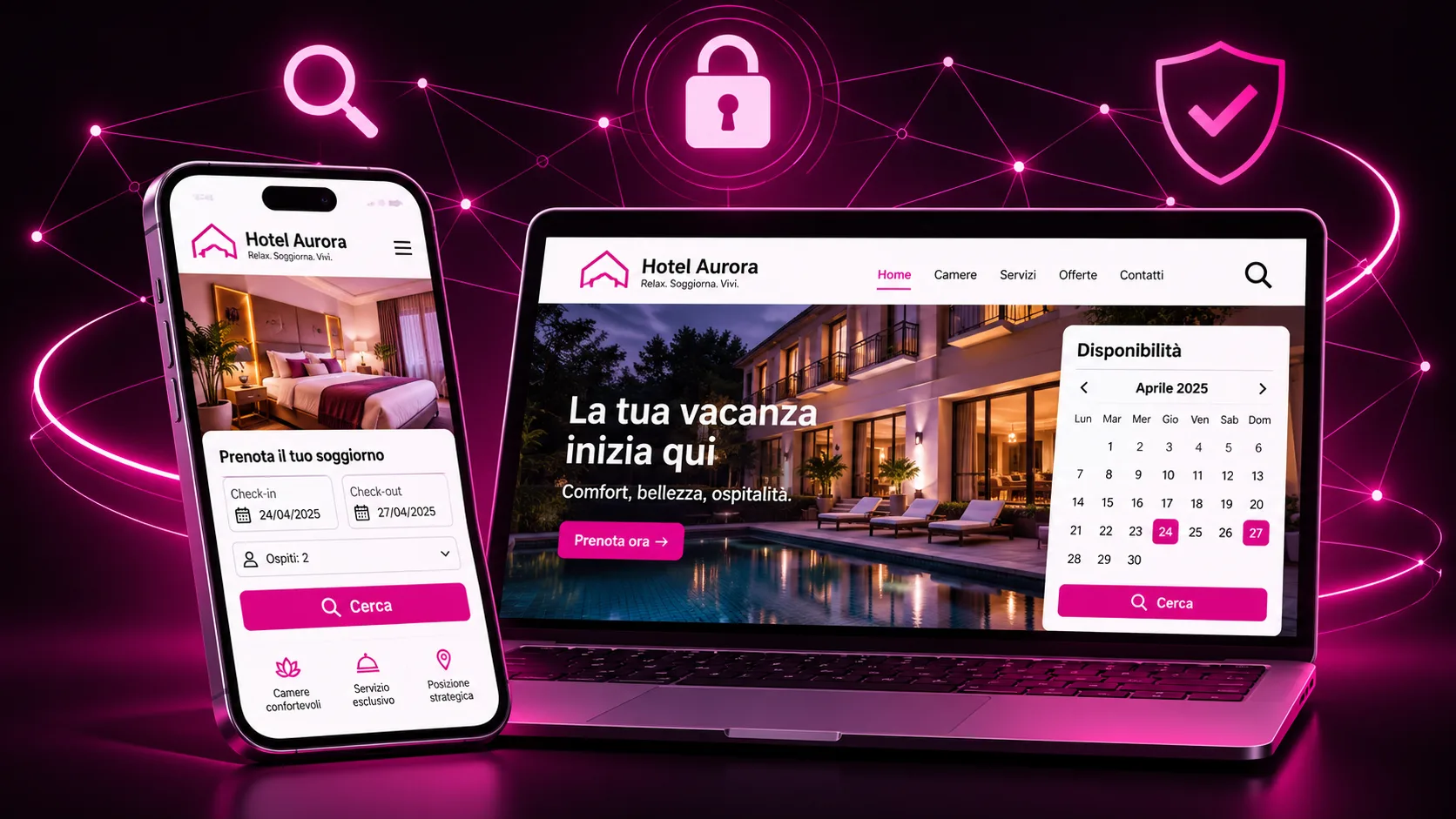
Most guests search, and often book, on their phone. Your site should be designed for small screens first: text readable without zooming, large buttons, a simple menu, and tap-to-call and WhatsApp links.
Fast to load
Every second of waiting costs you visitors. The usual culprits are oversized images, unnecessary add-ons and underpowered hosting. Compress your photos, use modern image formats and check performance regularly with free tools such as Google PageSpeed Insights.
Secure and transparent
The padlock of an SSL certificate (an address starting with https) is the bare minimum. On top of that, show clearly who you are: company name, VAT number, address and contact details. A guest about to pay wants to know who they are dealing with.
Photos and descriptions that make guests want to come
Images are the first thing guests look at. Use bright, landscape, up-to-date photos taken with care: rooms, bathrooms, outdoor areas, breakfast, pool, surroundings. Avoid old or heavily edited pictures: they set the wrong expectations and lead to disappointing reviews.
Descriptions should answer guests' practical questions:
- how many people each room or unit sleeps, and with which beds;
- which amenities are included and which cost extra;
- parking, pets, accessibility, check-in and check-out times;
- what's nearby and how to get there.
Write simply, as if you were talking to a guest on the phone. Fewer adjectives, more useful information.
Booking engine: book in a few clicks
A website without online booking forces guests to send a message, wait for a reply and perhaps get a quote the next day. By then, they have already booked somewhere else.
A booking engine shows live availability and rates and lets guests book and pay straight away. To work well, it should:
- be connected to your property management system and channel manager, so availability stays in sync with the OTAs;
- show the final price clearly, including taxes and extra fees;
- ask only for the data you really need, in a few steps;
- accept the most common payment methods and confirm the booking by email instantly.
Tip: give guests a reason to book on your website, such as a perk reserved for direct bookings (breakfast included, late check-out, more flexible cancellation terms). Before offering different rates, check the terms of your OTA contracts.
Easy contact and clear calls to action
Not everyone is ready to book on their first visit: some want to ask a question first. Make contact effortless with a WhatsApp button, a tap-to-call number, email and a short, spam-protected form.
Every page should have one clear main action, such as "Check availability" or "Book now". Don't crowd the page with competing buttons: too many choices confuse visitors.
SEO and structured data: get found by Google and AI assistants
A beautiful website nobody finds won't bring bookings. Here are the basics:
- Page titles and descriptions using the words guests search for, such as the type of property and the location.
- One page per room or unit type, with original copy rather than text copied from OTAs.
- A complete Google Business Profile consistent with your website: name, address, phone, opening hours, photos.
- Structured data (schema.org) describing your property, address, amenities and FAQs in a machine-readable way.
- Helpful content, such as local guides and answers to common questions, which helps search engines and AI-powered assistants understand who you are and whom to recommend you to.
Languages, practical information and legal requirements
If you host international guests, your site should be available at least in English, with carefully reviewed translations. Practical pages matter too: how to get there, house rules, cancellation policy, FAQs.
Some elements are required by law, such as a privacy policy, cookie management and your company details.
Good to know: in Italy, hotels, holiday homes and short-term rentals must display their CIN (Codice Identificativo Nazionale, the national identification code issued by the Ministry of Tourism) in every listing, wherever it is published, including their own website. Some regions also require a regional code. If your property is in Italy, check the latest rules on official national and regional channels.
A living website: measure and improve over time
A website is never finished. Connect an analytics tool and watch a few key numbers: how many visits you get, where they come from, how many people open the booking engine and how many complete a booking.
If many guests start booking but drop off halfway, the problem lies in the booking process. If visits are low, work on SEO and content. Update photos and copy whenever something changes at your property, and regularly check that forms, links and payments work. Small, steady improvements are worth more than a full redesign every few years.
Common mistakes to avoid
- Sending guests to an OTA instead of having your own booking system.
- Showing outdated rates or availability.
- Using a long contact form with unnecessary required fields.
- Hiding extra fees until the last step.
- Leaving the site untouched for years, without updating photos, copy and amenities.
The must-have elements at a glance
| Element | Why it matters | How to check it |
|---|---|---|
| Mobile version | Most searches start on a smartphone | Try booking from your own phone |
| Speed | A slow site loses visitors | Test with PageSpeed Insights |
| Photos and descriptions | They persuade and reduce questions | Does every unit have full photos and details? |
| Booking engine | Turns visits into bookings | Availability in sync with the OTAs |
| Quick contact | Wins back undecided guests | Tap-to-call and WhatsApp links |
| SEO and structured data | They get you found | Search for your property type and location |
| Legal details | Trust and compliance | VAT number, privacy, cookies and codes visible |
Quick checklist
- The site is easy to read and use on a smartphone.
- The homepage loads in a few seconds.
- https, company details, privacy and cookie policies are in place.
- Every unit has up-to-date photos and complete descriptions.
- The booking engine shows real availability and a clear final price.
- Booking direct offers a perk compared with the OTAs.
- WhatsApp, phone and email are one tap away.
- Your Google Business Profile is complete and consistent with the site.
- The site is available at least in English.
- Required registration codes (such as the CIN in Italy) are displayed.
Want a website that brings in direct bookings?
ForGuest builds fast accommodation websites, optimised for smartphones and search engines and connected to your booking engine and management software. Tell us about your property and we'll show you what can be improved.
Frequently asked questions.
How fast should an accommodation website be?
As fast as possible: aim for the homepage to load in a few seconds, even on a smartphone. You can measure it for free with Google PageSpeed Insights.
Do I need a booking engine if I am already on Booking.com and Airbnb?
Yes, if you want direct bookings. Connected to your channel manager, it keeps availability in sync with the OTAs and prevents overbooking.
Should my website be available in more than one language?
If you host international guests, yes. A carefully written English version reaches a wider audience and also helps your visibility on search engines.
What is the CIN for Italian properties?
It is the national identification code that Italian accommodation and short-term rentals must show in every listing, including their own website. Check the details on official Italian tourism channels.
What is structured data?
It is information added to the page code following the schema.org standard, describing your property, address, amenities and FAQs in a way search engines and AI assistants can read.